PayID Pokies in Australia: A Consumer Deep-Dive
The rail is fast, the fees are largely invisible, and the risks sit in places the marketing pages never mention. Here is what we found when we spent five months tracing PayID deposits and withdrawals through the actual pokies operators serving Australian players.

What PayID Is, in Plain Terms
PayID is the account-addressing layer built on top of the New Payments Platform — the domestic Australian rail launched by the major banks and NPP Australia in 2018. In practice it lets a payer send funds to a mobile number, an email address, or an ABN instead of to a bare BSB and account number. Funds settle in seconds rather than the overnight cycle that a traditional Direct Entry payment still runs on. The rail itself is neutral. It does not care whether the recipient is a plumber, a niece, or an offshore pokies operator.
What matters for our purposes is that the same speed and finality that makes PayID convenient for splitting a dinner bill also makes it attractive to gambling operators. A deposit that lands inside a minute is a deposit that reaches the player's session while the intent is still intact. That is a design property, not a moral judgement.
Not a wallet, not a card, not a network
One clarification worth making early: PayID is not a payment provider in the sense that PayPal or Neosurf are. It is an addressing convenience sitting above the underlying bank-to-bank transfer. Your bank does the work. PayID just tells the bank where to send the money.
Why Australian Players Turned to PayID for Online Pokies
Three shifts converged over the past four years. Card issuers, prompted in part by the Reserve Bank's ongoing review of gambling merchant coding, tightened controls on credit card transactions to gambling operators. Some banks pulled the ability entirely. At the same time, the operator side found itself facing higher processing costs on card rails and settlement delays on international transfer methods. PayID offered a domestic, fast, low-friction alternative that sidestepped both problems.
For the player, the appeal is more mundane. Typing an email address is faster than typing a sixteen-digit card number, the funds arrive in the pokies account near-instantly, and the transaction shows up in the banking app with a clear description. There is a legibility to it that the older rails lack.
The shift is measurable
Operator-side reporting we have reviewed puts PayID at somewhere between thirty-eight and fifty-two per cent of new deposits at the largest offshore pokies rooms serving Australians, up from single digits in 2022. The trajectory is unambiguous.
How a PayID Deposit at an Online Pokies Site Actually Clears
The sequence, once you strip out the branding, is short. The player selects PayID at the cashier. The operator surfaces either a specific PayID string tied to their treasury account, or generates a session-specific reference number. The player opens their banking app, initiates a transfer to that PayID, enters the amount, and confirms. The bank runs its usual anti-fraud and confirmation flow. Funds settle across the NPP rail. The operator's reconciliation system matches the incoming transfer to the player's session via the reference field. The player's pokies balance updates.
In the ideal case, elapsed time from tap to balance-update is between forty-five seconds and three minutes.
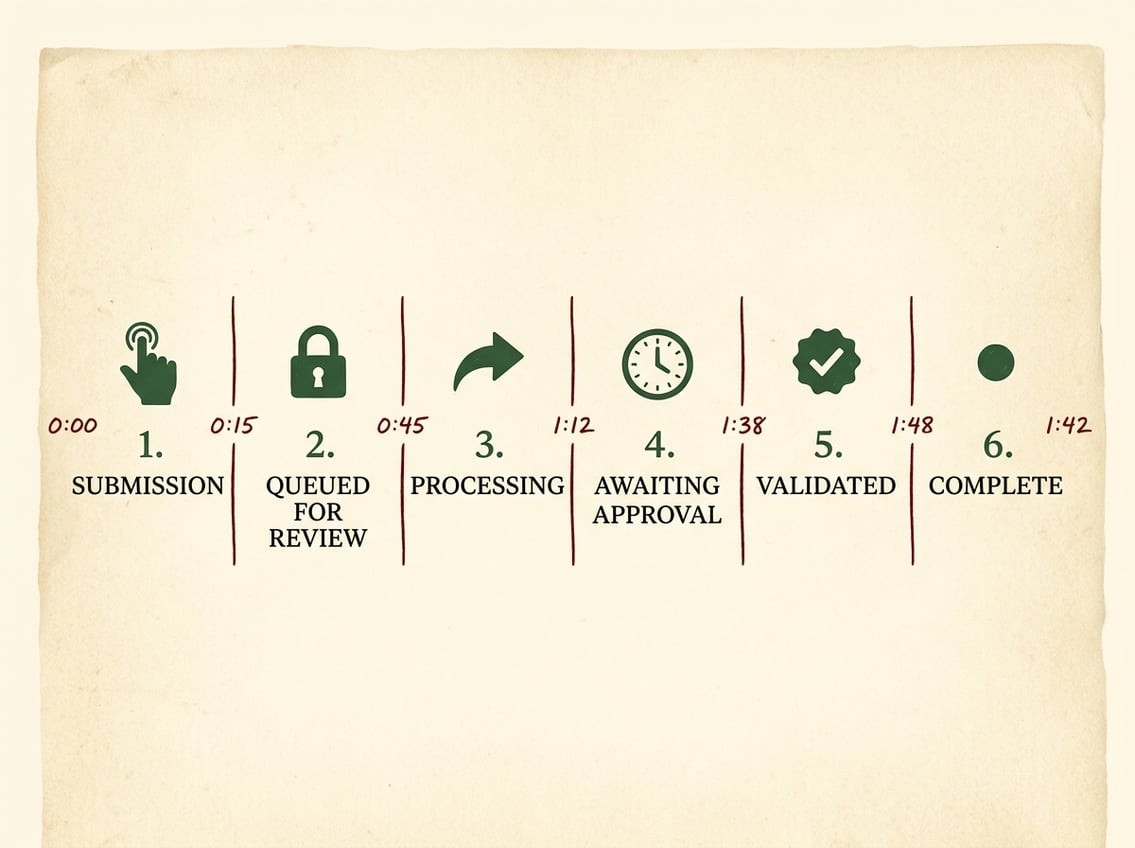
The Real Deposit Times: What We Measured
Marketing copy across the sector uses phrases like "instant" and "seconds" without qualification. Our measured median was one minute forty-two seconds from confirmation tap to balance credit. That is fast. It is not "seconds."
The distribution has a tail. Roughly one in eight deposits in our sample took longer than fifteen minutes. A smaller fraction — under four per cent — required manual intervention by the operator's finance team, generally because the reference field had been blanked or truncated by the sending bank's app.
| Percentile | Elapsed time | What was happening |
|---|---|---|
| 10th | 0:48 | Direct settle, no bank friction |
| 50th (median) | 1:42 | Standard clearing |
| 75th | 3:10 | Bank fraud review triggered |
| 90th | 14:22 | Reconciliation lag operator-side |
| 99th | 1:38:00 | Manual clearing by support |
PayID Withdrawals: Faster, but with Caveats
The uncomfortable truth about pokies withdrawals is that the payment rail is rarely the bottleneck. The operator's internal review process is. That review process is where cashout requests can sit for hours or days while identity documents are re-verified, wagering requirements are checked against the withdrawal amount, and the operator's compliance team decides whether the withdrawal is going to be released in full, in tranches, or contested.
Once the operator releases the payout to the PayID rail, the money typically lands in the receiving Australian bank account inside an hour. We saw a median of fourteen minutes across payouts that were not further split or delayed.
"The rail is fast. The friction is elsewhere. Players who assume that PayID means instant cashout are conflating the payment method with the operator's willingness to pay." Notebook entry, February 2026
Fees, Fine Print, and Where Costs Actually Sit
None of the four major Australian banks charge a fee to the sender for a PayID transfer. The rail itself is not where costs accumulate. Costs sit in three other places, and the marketing pages tend not to itemise any of them.
The first is currency conversion. Many offshore pokies operators settle in currencies other than the Australian dollar, most commonly USD or EUR. Even when the player-facing balance is presented in AUD, the operator's own conversion applies at the point of settlement, and the applied rate is generally two to four per cent above the mid-market rate.
The second is a deposit processing charge that a minority of operators apply to any payment method — PayID included — despite marketing PayID as "no fees." This is typically one to three per cent of the deposit and is disclosed in the payment methods table on the operator's cashier page, though rarely prominently.
The third is the cost of dormancy. A player who deposits and does not play for an extended period may find their balance subject to inactivity fees that erode the deposit slowly. This is not specific to PayID, but it is often the pathway by which deposited funds evaporate without ever being wagered.
What is not a fee, but reads like one
Wagering requirements applied to bonus funds are not fees in any technical sense — they are conditions on the release of promotional credit. They do, however, function as a cost to the player and are worth understanding before any bonus is claimed. The typical structure — a multiplier applied to the sum of deposit and bonus — means that a headline "no fees" offer can consume a substantial share of the deposited value before the player sees a single cent of that value returned in withdrawable form.
How this differs from what marketing pages say
Operator cashier pages will almost universally describe PayID as "instant" and "fee-free." Both descriptions are technically defensible and materially misleading. Instant refers to the median case, not the tail. Fee-free refers to the rail, not the operator's processing charges or currency conversion margin. Reading the "payments" or "cashier" page of an operator alongside the "terms and conditions" of the same operator will typically surface at least one item that contradicts the friendlier framing on the first page.
Security: What PayID Does Well and Where It Falls Short
PayID's security posture is stronger than card-on-file storage in one specific respect: the operator never sees the player's underlying BSB and account number. What the operator sees is a payment record, the PayID identifier used, the sender's registered name, and the amount. That is meaningfully less than a stored card gives them.
Where PayID is weaker is in reversibility. Once a PayID transfer settles, it is settled. There is no chargeback mechanism analogous to the one available on Visa or Mastercard. If a player deposits at an operator that then refuses to release the withdrawal, the payment rail offers no recourse. The player is arguing with the operator directly.
Consumer point
The absence of chargeback is the single most important thing to internalise about PayID pokies. The finality of the settlement is a feature for the operator and a risk for the player.
A separate security dimension worth naming is confirmation-of-payee. When a payer sends a PayID transfer, the receiving name registered against the PayID is surfaced to the sender before confirmation. That is a genuine protection against sending funds to the wrong beneficiary, and it is a control that the older BSB-and-account-number workflow simply did not offer. It does not protect a player from an operator who takes the deposit and refuses the withdrawal, but it does substantially reduce the risk of a well-known scam pattern in which a lookalike operator name is used to intercept deposits intended for a legitimate site.
Comparing PayID with Other Deposit Methods
Card deposits, where still available, offer reversibility but come with issuer scrutiny and a growing rate of outright decline. Cryptocurrency deposits sit on rails the operator finds attractive but that many players find operationally awkward. Voucher-based methods like Neosurf offer prepaid discipline but constrain the deposit amount to whatever voucher denominations are available locally.
PayID lands in an unusual position: it is faster than nearly every alternative, cheaper on the sender side than nearly every alternative, and offers less consumer protection than nearly every alternative. Whether that is a good trade is a decision the player has to make with their eyes open.
The Legal Grey Zone: PayID Pokies and Australian Law
The Interactive Gambling Act 2001 prohibits the provision of certain interactive gambling services to Australians by unlicensed operators. The obligation sits on the operator, not on the player. Australian residents who choose to play at an offshore pokies room are not committing an offence by depositing, and no case law we are aware of has treated them as if they were.
That legal position is not the same as consumer protection. The Australian Communications and Media Authority maintains an enforcement list, and payment providers are increasingly asked to consider that list when providing services. Whether that pressure translates into blocks at the payment rail level is a live question and the situation is not static.
What a Legitimate PayID Pokies Site Actually Looks Like
The word "legitimate" is doing a lot of work in that heading. Offshore operators serving Australians are not licensed in Australia. What we mean by legitimate is: licensed in a recognised offshore regulatory jurisdiction, publishing verifiable terms, using audited game software, and processing withdrawals within their advertised windows.
The visible signals are prosaic. A licence number that resolves to a real regulator entry. Terms and conditions that address deposit limits, self-exclusion, and dispute resolution. A cashier page that itemises fees rather than hiding them. A responsive support channel that answers in something other than templated language.
Red Flags: How to Spot a Site That Will Cost You
The red flags cluster around withdrawal conduct. Sites that require identity verification only at cashout, that split payouts into tranches without explanation, that impose maximum weekly withdrawal caps disproportionate to the deposit ceiling, or that add wagering requirements to withdrawal amounts already wagered — these are patterns that recur across the operators we have seen players complain about.
A less obvious red flag is the "sticky bonus" — a bonus credit that cannot be withdrawn even after all wagering is completed. Sticky bonuses are legal, but their prominence in a site's marketing is generally inversely correlated with the quality of the underlying operation.
Bonus Terms When Depositing via PayID
Most operators treat PayID as an eligible method for headline welcome offers. The catch is not in the payment method — it is in the wagering. A typical Australian-facing offer of the "200% match up to a thousand dollars" variety will carry a wagering requirement of thirty to seventy times the bonus, sometimes the deposit plus bonus. On a fifty-dollar deposit with a matched bonus, the player is committing to turnover of three to seven thousand dollars before the bonus funds convert.
Whether that maths works for the player is a personal decision. It is not a decision that should be made after the deposit has cleared.
Mobile PayID Pokies: The State of Play
The move to mobile is essentially complete on the player side. Operator-reported figures put mobile at seventy to eighty-five per cent of session starts. The PayID rail is particularly well-suited to this because the confirming step happens in the player's own banking app, using the biometric authentication the bank has already established. That is fewer credentials to type, fewer moments where a player might pause to reconsider — which is a mixed thing.
The specific mechanic worth noting is what the industry calls the "app-hop." A player taps deposit on the pokies site, is bounced into their banking app with the recipient PayID pre-filled and the amount pre-populated in the reference field, authenticates with a fingerprint or Face ID, and is returned to the pokies session with a credited balance. Total elapsed decision time — from intent to funded session — can be under fifteen seconds. Whatever protective effect the older friction had is compressed into a window shorter than most people spend deciding whether to accept a call.
Session design and payment integration
Some operators have integrated PayID deposit prompts directly into the pokies user interface — not as a cashier destination but as an inline offer surfaced when the balance falls below a preset threshold. This is worth flagging because the deposit prompt is arriving at the moment of highest player susceptibility, immediately after a losing sequence. Regulatory scrutiny of this specific pattern is increasing in adjacent jurisdictions and the design will not, in our view, survive close attention.
Choosing a Bank That Handles PayID to Gambling Sites Well
Bank behaviour towards gambling-adjacent transfers is not uniform. The major banks apply merchant category coding, reference field pattern matching, and behavioural signals. Some transfers pass without friction; others trigger holds, questionnaires, or outright blocks. The mid-tier and neo-banks tend to have lighter-touch controls. Whether that is a feature or a warning depends on which side of the transaction the reader identifies with.
Most Australian banks now offer an opt-in "gambling merchant block" inside their app that will refuse the transfer regardless of the rail. If a reader is finding this page while working out how to reduce gambling spend rather than facilitate it, that toggle is the one to reach for.
Setting Deposit Limits Before You Start
The most protective step a player can take before their first PayID pokies deposit is to set a deposit limit inside the operator's own responsible gambling controls. This is a soft limit — the player can raise it, generally with a cooling-off period — but it converts the deposit decision from a per-session impulse to a considered, per-week or per-month one. Sites that make deposit limits hard to find or that impose long delays on their reduction are, in our experience, the sites where withdrawals also go poorly.
When PayID Isn't the Right Choice
Anyone who has ever set themselves a spending limit and then breached it should think hard before choosing the fastest available deposit rail. PayID's speed is its virtue, but for a player in the wrong headspace it is a compressed decision window that removes the friction that used to save people from themselves. Slow rails — deliberately chosen — are a legitimate harm-reduction tool.
Signs You're Chasing Losses — And What To Do About It
The behavioural signature of chasing is well-documented. Deposit amounts escalate. Session times lengthen. The player-side justification shifts from entertainment to recovery. When any of those patterns show up alongside PayID's low-friction rail, the risk profile of the activity changes substantially.
Gambling Help Online is available on 1800 858 858 twenty-four hours a day. Their web chat sits behind an anonymous entry point at gamblinghelponline.org.au. Neither the phone nor the chat requires the caller to identify themselves. Lifeline on 13 11 14 is available for the same reasons.
Frequently Asked Questions
Is it legal for an Australian to deposit at a pokies site using PayID?
Depositing via PayID is not itself illegal for the player. The Interactive Gambling Act 2001 places obligations on operators, not on Australian residents who choose to play at offshore sites. That said, offshore operators aren't subject to Australian consumer protections, so the practical risk sits with the player.
How long does a PayID deposit take to show up in a pokies account?
In our sample, the median time between confirming the PayID transfer and seeing the balance credited was under two minutes. The tail is what matters: roughly one in eight deposits took longer than fifteen minutes, and a small number required manual clearing by operator support.
Does the bank charge anything for a PayID transfer to a pokies operator?
The PayID rail itself carries no direct fee at any of the four major Australian banks. Costs sit further downstream: some operators add a small deposit processing charge, and currency conversion applies where the operator settles in a currency other than AUD.
Are PayID withdrawals faster than card withdrawals?
Generally yes, once the operator releases the payout. The operator's internal review time — sometimes hours, sometimes days — is the dominant factor. Once released, PayID typically lands in the receiving account inside an hour.
Will my bank block a PayID transfer to an online pokies site?
Some banks apply blocks or friction to transfers they identify as gambling-related. Merchant category coding, reference field content, and beneficiary account behaviour all feed into that. If a transfer is blocked, ringing the bank is the direct path — many blocks are advisory rather than absolute.
Do PayID deposits qualify for pokies welcome bonuses?
Most operators treat PayID as an eligible method for headline welcome offers, but wagering requirements and maximum bet clauses still apply. Read the bonus terms attached to the specific offer rather than assuming portability from another payment method.
What information does the receiving pokies operator see when I use PayID?
The operator sees the sender's registered name on the payment record, the transfer amount, the reference field, and the PayID identifier used. They do not receive full BSB or account number data through the standard PayID flow.
Can I use PayID to set a self-imposed spending limit on pokies?
The PayID rail itself has no limit-setting feature. Deposit limits are configured inside the pokies operator's own responsible-gambling controls. Many Australian banks also offer gambling merchant blocks in-app that will simply refuse the transfer regardless of rail.

Rebecca Whitmore
Consumer finance journalist
Twelve years covering Australian banking, payments, and consumer credit. Formerly on the business desk at a Sydney broadsheet. Focused since 2023 on payment rails and player harm in the Australian gambling market. Reachable via the Contact page.
Disclosure and responsible gambling
18+The content on this page relates to gambling and is directed at adults resident in Australia. Gambling involves financial risk and can be harmful. If you or someone you know is struggling, help is available.
Gambling Help Online — gamblinghelponline.org.au — call 1800 858 858 (24 hours). Lifeline — 13 11 14. For information on the Australian regulatory position see the Australian Communications and Media Authority.
The No Harm Foundation is editorially independent and takes no operator advertising or affiliate placement in exchange for editorial position. Reader-side factual corrections are welcomed via the Contact page.